


Trials of Maya: A Game of Champions, Cards, and Choices


Some games are easy to explain. You sit down, draw some cards, move some pieces, and before long everyone understands what they are supposed to be doing. Then there are games like Trials of Maya.
The first thing you notice is the amount of stuff happening in the box. There are characters, cards, abilities, boards, tokens, towers, minions, and enough possibilities that you can spend a fair amount of time just looking at everything before you start playing. But once you get past that first impression, the interesting part of Trials of Maya isn't how much is in the box. It's what all of those pieces allow you to do.
At its heart, Trials of Maya is a competitive tactical game about taking control of your character, building around its abilities, and figuring out how to turn the cards in your hand into an advantage on the board. It is sometimes described as a tabletop MOBA, but that comparison is really just a quick way of explaining the setting and structure. The game itself is much more concerned with what happens when you put a group of very different characters, abilities, and strategies into the same arena.
And that's where things get interesting.
Everyone Has a Different Plan
The most important thing about Trials of Maya is that the characters don't all feel like variations of the same thing. They give you different tools, and that means your approach to the game starts before you even play your first card. You have to think about what your character wants to accomplish, what kinds of cards work well with that character, and what your opponent is likely to do when you give them an opportunity.

That creates a nice progression from game to game. The first time you play a character, you're probably figuring out what everything does. The second time, you start seeing combinations. Eventually, you aren't just playing the cards that look useful. You're building a strategy around the character and trying to put yourself in situations where your abilities are most effective.
That's one of my favorite things about games with asymmetric characters. You don't simply learn the rules. You learn how to play your game within the larger game.
The Cards Change Everything
The card system is where a lot of the personality of Trials of Maya comes through. Cards aren't simply there to give you another thing to do on your turn. They give you options, and those options become more interesting when you start thinking about how they interact with your character and the board.
That creates some of those wonderful tabletop moments where you look at your hand and realize you have several perfectly reasonable choices. Unfortunately, you can only choose one.
Do you use what you have now and get an immediate advantage? Do you hold something back for a better opportunity? Do you concentrate on your own position, or do you spend your turn making sure the other player doesn't get to do what they clearly want to do?
Those decisions are where a game like this earns its keep. It's not difficult to make a game where players have lots of choices. It's much harder to make those choices feel meaningful.
Trials of Maya is at its best when the cards force you to make those decisions.
It's Not Just About Beating Someone Up
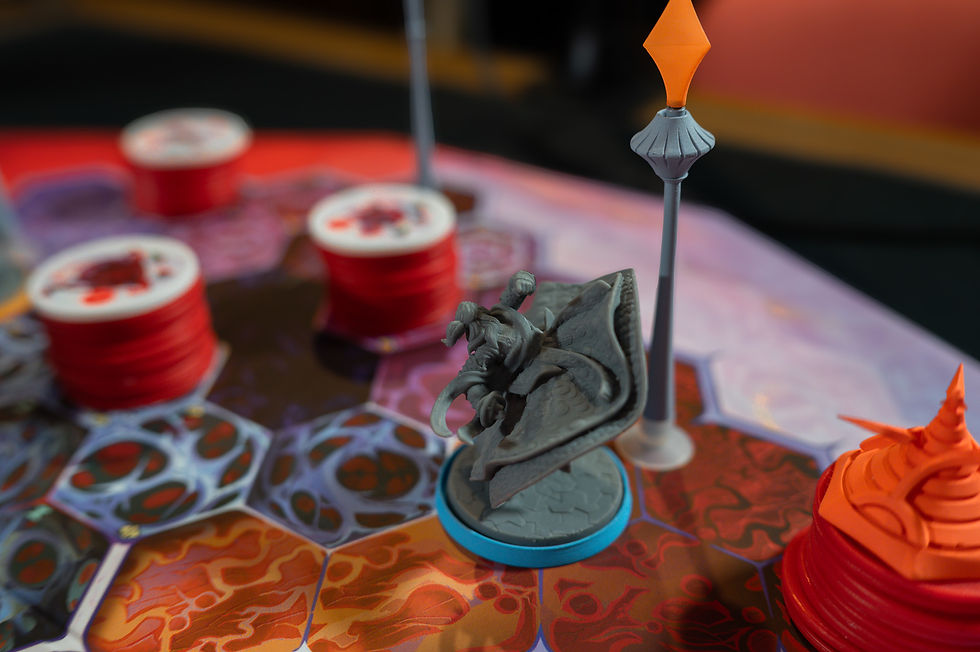
Combat is obviously an important part of the game, but I don't think that's the most interesting thing happening. Position matters. Timing matters. Knowing when to commit matters. And sometimes the best move isn't the one that does the most damage.
That's a distinction I appreciate.
If every turn simply comes down to "What can I do to hurt my opponent the most?" then a game can become repetitive pretty quickly. Here, the board creates additional problems. You have objectives to think about, other characters to account for, and you have to consider where you are going to be rather than just what you are going to do.
That creates a little more tension. You can have a fantastic turn planned out and then discover that getting yourself into the right position is actually the difficult part. Or you can spend several turns setting something up, only to have another player recognize what you're doing and force you to change direction.
That's the sort of interaction I want from a competitive game.
Learning the Game Is Part of the Game
There is definitely a learning curve here. I'm not going to pretend otherwise. There are a lot of cards and a lot of different interactions to understand, particularly when you start playing different characters.
But I think that's also where much of the replayability comes from.
There is a difference between knowing what a card does and understanding when you should play it. The same thing is true of the characters. The first few games can be about discovering the possibilities. Later games can be about exploiting them.
That is a much more interesting kind of complexity than simply adding more rules. The game gives you a toolbox. You have to figure out what to build with it.
A Lot of Game in the Box
Trials of Maya is not a small, quick game. The advertised play time can stretch from around an hour to several hours depending on the mode and player count, and there is enough content to support repeated plays. The game includes nine champions, multiple game modes, and a large collection of cards.
This isn't the game you're going to pull out when someone says, "We've got about 45 minutes before everyone needs to leave." This is a game-night game. It's the game you bring out when everyone is willing to settle in and spend some time learning what their characters can do.
And I think that's perfectly fine.
Not every game needs to be short. Sometimes you want something that gives you enough room to develop an idea.
The Best Moments Come From the Players
One of the things I look for in a game like this is whether the interesting moments come from the rules or from the players.
The rules can give you all the tools in the world, but if everyone simply follows the obvious sequence every turn, eventually you're going to feel like you're operating a machine. The more interesting possibility is when the game gives players enough freedom to create their own stories.
Someone takes a risk. Someone else sees an opening. A carefully planned attack doesn't work. A character that looked dangerous turns out to be much more difficult to deal with than expected. Someone pulls off a combination that nobody saw coming.

Those are the moments that make a game memorable.
And Trials of Maya has plenty of room for those moments.
Who Is This For?
I think the biggest question isn't whether Trials of Maya is complicated. It is. For some players it will be too much. For others who are familiar with deck crafting and miniatures games it is a medium complexity game. The better question is whether you enjoy the kind of game that rewards you for learning it. This game has strategic depth to reward multiple, repeat plays, and it is also fun right out of the box.
If you like asymmetric characters, tactical combat, card combinations, and games where you gradually become better at understanding the systems, there is a lot to explore here.
If you prefer games where everyone has essentially the same options and the rules can be explained in five minutes, this probably isn't going to be your first choice.
And that's okay.
One of the things I appreciate about modern board gaming is that there is room for both. Sometimes I want to play a game that I can teach in ten minutes. Other times I want to sit down with a character, stare at a deck of cards, and spend the next couple of hours figuring out how everything fits together.
Trials of Maya is very much the second kind of game.
Final Thoughts
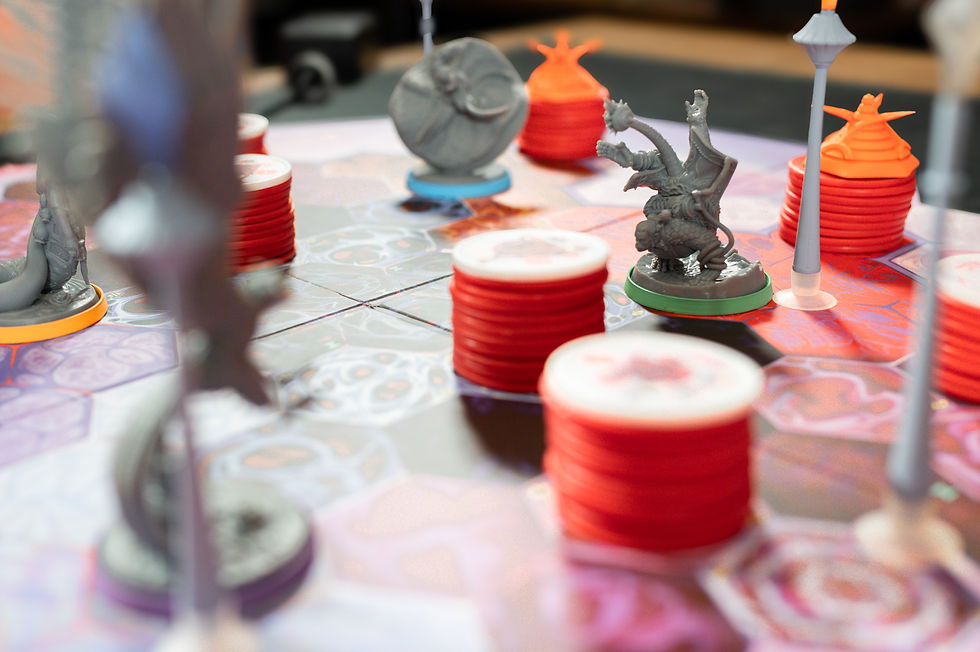
There is a temptation with a game this large to focus on everything it contains. Nine champions. Multiple modes. Hundreds of cards. Minions. Towers. Abilities. Boards.
All of that is impressive, but none of it matters if the actual decisions aren't interesting.
Fortunately, that's where Trials of Maya caught my attention.
Underneath all of the components is a game about figuring things out. Figuring out your character. Figuring out your cards. Figuring out your opponent. Figuring out when to take a chance and when to wait. And, occasionally, figuring out how the plan you spent the last three turns preparing just went completely sideways.
Those are the games I tend to enjoy. Not necessarily because they are easy. Not because they have the most stuff. But because they give you something to think about.
Trials of Maya gives you quite a bit to think about.

Review prototype copy provided by the publisher. My opinions are my own.
Trials of Maya
Designed by: Anand Gandhi, Aayush Asthana, Zain Memon, Yash Patel, and Ahan Sahoo
Published by: Department of Lore
Aesthetics 9.5/10
Strategy 8/10
Gameplay 9/10


Comments